Do you get a piercing pain when drinking hot coffee, eating ice cream or brushing your teeth? If yes, then you might have been suffering from sensitivity in teeth. An ordinary dental complication that occurs to people of every group. Little sensitivity now and then is nothing to worry about, but when the discomfort lingers, it can signal that there’s something wrong underneath needing professional treatment.
At Maruti Dental Clinic, we provide personalized diagnosis and advanced treatment options to relieve sensitivity in teeth and help patients enjoy their favorite foods and beverages without pain.
What Is Sensitivity in Teeth?
Tooth sensitivity, also referred to as dentin hypersensitivity, is a pain or discomfort that the teeth present under stimulus such as hot and cold foods, acidic or sweet foods and gusts of cold air.
An outer hard layer of enamel covers each tooth. They are made of enamel over a material called dentin that is kind of like the rubber in tires, and these tubes lead to nerve tissue inside it. The tubules become exposed when enamel wears away or gums recede, allowing any external stimuli to reach the nerve and then causing pain.
Indeed, this pain may only be temporary but recurrent tooth sensitivity should always need attention.
Common Causes of Sensitivity in Teeth
Understanding the cause helps determine the best treatment.
1. Worn Tooth Enamel
Teeth enamel protects your teeth from injuries. Attrition of enamel from aggressive tooth brushing, excessive use of hard-bristled toothbrushes or acidity in foodstuff can lead to tooth sensitivity.
2. Gum Recession
The gum line becomes exposed, with the gum recession. Roots are free of enamel protection which is why they are extremely sensitive to temperature changes.
3. Tooth Decay
Cavities leave openings that allow some to expose the innermost center of the teeth and make it more sensitive.
4. Cracked or Chipped Teeth
Cracks open the tooth up to bacteria and food debris that can nestle down into sensitive areas, giving rise to acute pain and increased sensitivity in teeth.
5. Teeth Grinding (Bruxism)
Inevitably, night-time teeth grinding grinds down enamel over time which in turn leads to increased tooth sensitivity.
6. Recent Dental Procedures
Teeth may be sensitive for a limited time after treatments such as fillings, crowns, teeth whitening or scaling. This generally lasts a few days.
7. Acidic Foods and Drinks
Regular consumption of foods and liquids such as citrus fruits, soft drinks, vinegar and sports drinks can dissolve enamel and sensitize teeth.
Symptoms of Sensitivity in Teeth
The level depends from person to person. Common symptoms include:
- Feels like sharp pain while drinking hot or cold beverages
- Pain with eating ice cream or pain with cold foods
- Sensitivity to sweets
- Discomfort while brushing or flossing
- Pain when breathing cold air
- Pain on chewing acidic foods
If these symptoms occur regularly, consult a dentist for evaluation.
Who Is at Risk?
You may have a higher risk of developing sensitivity in teeth if you:
- Brush aggressively
- Consume acidic foods frequently
- Smoke or use tobacco
- Have gum disease
- Grind your teeth
- Have untreated cavities
- Skip regular dental check-ups
Treatments of Sensitivity in Teeth
The optimal treatment depends on the underlying etiology.
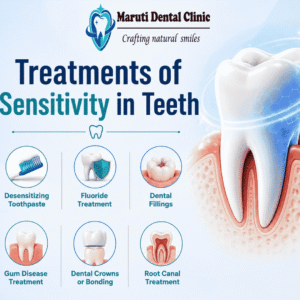
1. Desensitizing Toothpaste
Certain toothpaste contains substances that pain signals don’t reach to the tooth nerve. Most people experience less discomfort after some weeks of regular use.
2. Fluoride Treatment
For that, dentists can apply fluoride varnish or gel to produce stronger enamel as well as lower sensitivity.
Fluoride treatments at Maruti Dental Clinic may be one of the best cures for mild tooth sensitivity.
3. Dental Fillings
If sensitivity is due to cavities or worn tooth surfaces, fillings are used to restore the tooth and protect exposed dentin.
4. Gum Disease Treatment
If that gum recession is to blame, treatment of the gum disease protects those exposed roots, reducing discomfort.
5. Dental Crowns or Bonding
Crowns or dental bonding cover any areas of the tooth that have been worn down or weakened, soothing discomfort associated with cracked or severely worn teeth.
6. Root Canal Treatment
In the worst case, the impact on the tooth nerve is to such an extent that pain relief can only be achieved permanently with a root canal treatment.
How to Stop Sensitivity in Teeth
It is better to prevent than to always treat. Follow these simple tips:
- Gently brush with a soft-bristled
- Use fluoride
- Floss every
- Avoid excess Acidic diet and
- Use a night guard for teeth grinding
- Limit sugary snacks and
- See your dentist every six months
- Treat cavities and gum problems
Following these habits can drastically avoid the chances of teeth sensitivity.
Why Choose Maruti Dental Clinic?
We, at Maruti Dental Clinic, understand that every patient has a different degree of dental sensitivity. Before prescribing treatment, our qualified dentists conduct a thorough examination to determine the precise cause.
Our services include:
- Comprehensive dental examinations
- Digital diagnosis
- Fluoride therapy
- Tooth-colored fillings
- Gum disease treatment
- Dental crowns and bonding
- Root canal treatment
- Preventive dental care
With the help of modern technology and patient-centric approaches, we offer proven long-term relief from sensitivity in teeth where you can feel comfortable during all steps.
When Should You Visit a Dentist?
Consult a dentist immediately if:
- Tooth sensitivity lasts for several
- Pain becomes severe or
- You observe that your gums swell or
- You have a broken or chipped
- Sensitivity interferes with eating or
The earlier it is diagnosed, the less damage has been done, and therefore the more chance of keeping your teeth healthy.
Conclusion
Tooth sensitivity is a very common dental issue, but it should never be ignored. Though selecting home remedies and desensitizing toothpaste can help relieve the discomfort for a while, problems for sensitive teeth which is persistent in nature normally need expert care.
Our conventional approach at Maruti Dental Clinic assist all patients to attain pain-free smiles through bespoke dental treatment and preventive dental care. Regardless of whether sensitivity was caused by eroded enamel, gum recession or tooth decay, our team has the right solution to restore your oral hygiene.
Book a consultation with Maruti Dental Clinic today if tooth sensitivity persists. Once you start the treatment, it can prevent complications, relieve discomfort and enable you to enjoy your favorite food and drink confidently again.